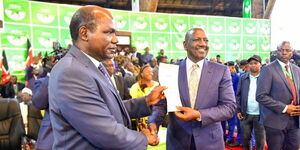

President William Ruto has announced that the government intends to stop external borrowing to finance development projects within 10 to 20 years, in an attempt to address the country's growing foreign debt deficit.
Speaking at a breakfast meeting with administrative officers at State House in Nairobi during the launch of the Jukwaa la Usalama Report, President Ruto said that the government would rely more on the securitisation of Kenyans' savings in the National Social Security Fund (NSSF) to fulfil its financial and development obligations.
He explained that this shift in strategy was the reason behind the recent increase in NSSF contributions.
He added that this would help Kenya to reduce its reliance on foreign borrowing, which has previously forced the nation to pay high interest rates to its creditors.

“The money we have collected in the last 60 years with NSSF amounts to Ksh320 billion by December 2022. Since we embarked on the new model, by the end of this month, our savings will be at Ksh670 billion. By June 2027, we will have Ksh1 trillion,” Ruto said.
He added that Kenya’s current reliance on external loans, particularly from China, could be replaced in the future by locally generated savings.
“China’s money that we are borrowing comes from their savings, which amount to 55 per cent of their GDP. We plan that in 10 to 20 years, we will not be borrowing money from China and instead use our own generated savings to fund our development projects,” Ruto said.
In Kenya, contributions to the NSSF are shared between employees and employers. For most workers, both the employee and employer contribute roughly the same amount each month, with combined totals ranging from about Ksh960 for lower-income earners to Ksh8,640 for higher earners.
The contributions are designed to build a retirement savings fund, ensuring workers have financial support after retirement. The exact amount depends on monthly earnings, but generally, each party contributes between Ksh480 and Ksh4,320 per month.
For 2025, the contribution rules were revised such that both employee and employer contribute 6 per cent of pensionable earnings. This means contributions are capped, with the maximum monthly payment by either party at Ksh4,320.
Meanwhile, Ruto revealed that when he assumed office after the 2022 general elections, he had to summon COTU Secretary General Francis Atwoli and other trade unionists to end a protracted legal battle that had stalled Kenyans’ contributions, which had been fixed at only Ksh200 per month for both employee and employer.
“We had a law that was passed in 2015, but Atwoli and his friends took us to court. I said that would be the first thing I would work on if I got to the Presidency, so I had to call him to my office here when I was elected and told him that that had to stop. We reached an agreement,” Ruto said.