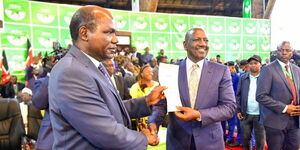

President William Ruto revealed that the country could be subjected to a surge in load shedding if it goes ahead with the ambitious data center projects.
Speaking during the unveiling of the Jukwaa La Usalama Report on Tuesday, December 2, 2025, President Ruto stated that Kenya’s current 3,300MW electricity capacity is insufficient to meet the demands of advanced technologies.
He compared Kenya’s production with Ethiopia’s Grand Renaissance Dam, which was officially inaugurated on September 9, 2025, and generates 5,400MW from a single facility.
“All of Kenya’s dam produces 3300 MW, but one dam in Ethiopia produces 5400MW, can’t you all see we have a problem. We produce little electricity,” Ruto stated.

He explained that the challenge is already visible in daily life, pointing to evening load shedding between 5 pm and 10 pm when demand peaks.
The President stressed that Kenya must urgently expand its generation capacity to 10,000MW within five years, a project he estimated will cost KSh 1.25 trillion.
Ruto linked the urgency to Kenya’s recent deals with Big Tech firms.
During his state visit to the United States in May 2024, he signed a Ksh130 billion agreement for a geothermal-powered data center involving Microsoft, UAE-based AI firm G42, and local partner EcoCloud.
However, he expressed dissatisfaction with Kenya’s preparedness to have such ambitious projects, as one data centre uses 1000MW of electricity, which is a third of the country’s production.
“One data centre requires 1000MW of electricity. We produce 300MW. Do you want me to subject half of the country to darkness by giving out 1000MW for the data centre.” Stated President Ruto.
He noted that such projects are crucial for Kenya’s ambition to move from a third-world to a first-world economy, but warned that without sufficient electricity, they could leave half the nation in darkness.