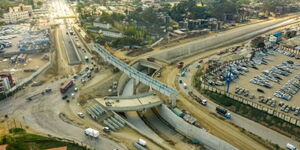

The Kenya National Highways Authority (KeNHA) has announced significant progress in the construction of the World Bank-funded 750-kilometre highway, which links Isiolo and Madera counties with plans to begin stakeholder engagement for the next phases in place.
The 750 Kilometre highway is currently the largest single road project in Kenya's history, a massive undertaking aimed at transforming Northeastern Kenya by connecting Isiolo, Garissa, Wajir, and Mandera counties.
In a notice dated Tuesday, December 9, the Authority revealed plans to begin the construction of the second phase, 70-kilometre Modogashe-Samatar and the third phase, 76-kilometre Rhamu-Madera routes, which form part of the 750-kilometre highway.
This follows the near completion of the first phase of the road, the 195 kilometres Isiolo–Modogashe route, whose construction began in May this year and is expected to end at the start of next year.

The highway, which is currently being designed under the Horn of Africa Gateway Development Project (HoAGDP), will also involve the construction of 17-kilometre link roads within Meru County.
While announcing plans to upgrade the remaining sections of the highway, KeNHA stated that it would be conducting market engagement for the relevant stakeholders to share information on the scope, anticipated timelines, and procurement approach.
The market engagement also seeks to gather market insights on capacity, cost drivers, potential delivery risks, and implementation challenges.
KeNHA also seeks to obtain views on construction methodologies, phasing options, and access constraints to inform procurement planning and promote transparency in line with World Bank procurement principles.
Among those invited to participate in the market engagement forum are contractors, engineering consultants, suppliers, and infrastructure stakeholders for a non-binding information-sharing session ahead of the formal tendering phase.
Meanwhile, the multi-billion-shilling highway is also expected to connect Kenya to other neighbouring countries to the north, including Somalia, Ethiopia, Eritrea, and Djibouti.
The deal for the construction of the highway was first signed in March 2021 between the government, through the Frontier Counties Development Council (FCDC) and World Bank representatives.
Following the signing of the agreement, the World Bank's International Development Association went ahead to disburse an initial of Ksh81 billion for the commencement of the road network.