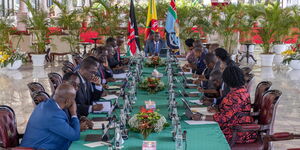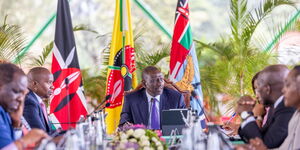

The Independent Electoral and Boundaries Commission (IEBC) has hosted a delegation from the Electoral Commission of Zambia (ECZ) on a peer learning and benchmarking tour in Kenya.
The ECZ delegation's visit is aimed at strengthening Zambia's electoral process and will learn from IEBC's electoral system as Zambia prepares for a general election later in August 2026.
The delegation, led by its commissioner Ndiyoi Mutiti, is holding discussions with IEBC to learn from Kenya's electoral processes and experiences and share best practices in electoral management.
The outcome of their visit is expected to inform Zambia's ongoing and future electoral reforms, notably after it amended its constitution and introduced a Mixed Member Proportional Representation (MMPR) electoral system.

The system combines the First Past the Post (FPTP) method with a Proportional Representation (PR) mechanism for electing women, youth, and persons with disabilities to Parliament and local councils.
Zambia aims to learn about best practices in electoral system designs, technology use, and inclusion mechanisms ahead of its general election.
IEBC uses advanced technologies and frameworks that are more integrated than Zambia's electoral systems. Iebc mainly uses KIEMS kits, a multifunctional tablet that uses fingerprint scanners and facial recognition to authenticate voters on election day so as to prevent election malpractice.
Access to the kits is restricted via unique passwords held by presiding officers. The devices utilise digital signatures and encrypted data storage to prevent tampering. In 2025, IEBC introduced advanced biometric technology that aimed to use voters' irises for verification.
The kits, currently supplied by the Venezuelan Smartmatic company, are equipped with accessories like power banks and chargers, and the commission has reported 99 per cent functionality of these kits.
Zambia currently relies on fingerprint and photo capture for its biometric voter registration and lacks the kits used by Kenya for verification.
While Zambia is conducting mobile registration, Kenya has a more advanced and established digital verification structure. Zambia also lacks the technology to flag deceased voters and identify new voters, and these took the central part of the benchmarking process.
According to reports, the benchmarking exercise forms part of Zambia's electoral commission's efforts to learn from comparative experiences, enhance operational efficiency, and adopt best practices in its electoral administration.