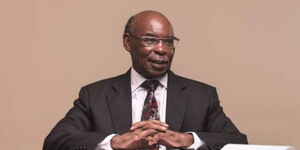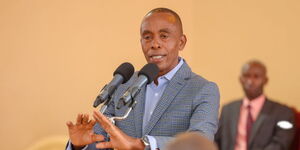

IEBC Chairman, Erastus Ethekon, delivered a post-election briefing on Monday, December 8, during the IEBC's Stakeholder Forum in Nairobi, offering a breakdown of how the November 27 by-elections were managed and highlighting where the electoral system still faces vulnerabilities.
In the televised address, Ethekon broke down the conduct of political parties, security agencies, aspirants, observers, and the media.
He termed the election as a multi-institutional undertaking rather than an affair run by the IEBC only, and revealed that the commission worked closely with various security agencies. He noted that the disruptions witnessed in various polling stations were not spontaneous but organised endeavours deployed to intimidate voters and officials.
Ethekon touched on the emergence of “super-agents,” individuals allegedly operating above the authority of ordinary party agents and attempting to interfere with polling station processes.

The IEBC boss went on to address disputes raised in Mbeere North, where some stakeholders demanded the disqualification of specific candidates. Ethekon clarified that IEBC could only act within the law and could not arbitrarily strike anyone out based on political pressure.
“We will not run elections on the basis of emotion or intimidation. The law guides every decision we make," the IEBC Chairman stated.
Regarding the enforcement of the Electoral Code of Conduct, the national returning officer discussed the Kasipul incident where two aspirants’ camps engaged in physical violence. Both leading candidates were fined Ksh 1 million. Ethekon stated that each candidate violated the electoral code of conduct, and the Commission penalised them uniformly.
Regarding media involvement, the CEO praised journalists for their support of transparency. However, he called for better coordination to prevent the spread of misinformation, especially during periods of high speculation, such as tallying times.
Ethekon went on to defend the IEBC’s impartiality throughout the by-elections. The CEO dismissed claims that certain aspirants received preferential treatment. He maintained that all decisions made by the Commission were documented and open to scrutiny.
The CEO encouraged citizens to report misconduct directly to the Commission, rather than waiting for disputes to escalate into violent confrontations on polling day.
Additionally, he lauded the government for availing funds for the by-elections but urged earlier disbursements, arguing that delayed releases weaken logistical planning and expose the Commission to unnecessary vulnerabilities.
Moreover, Ethekon said IEBC was open to ideas that would improve the commission’s mandate of deciding elections, including proposals to abolish the national tallying centre.
Ethekon urged political parties, security actors, and the public to adopt a culture of accountability, highlighting that the by-elections exposed both progress and persistent gaps that require addressing ahead of the 2027 national polls.
He concluded that engagement with stakeholders will allow IEBC to evaluate what worked well and address challenges observed on the polling day.