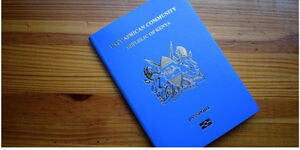

Behind every blue Kenyan passport is a tightly government-controlled process designed to balance national security, international travel standards, and the growing demand for travel documents in the country.
This delicate procedure often involves technology, international and national regulations, and security, which are engineered to ensure that these documents are authentic, traceable, and globally acceptable.
The process begins when an applicant submits a request for a passport through the e-Citizen platform, a stage that is aimed at reducing paperwork and creating a digital record that follows the passport through every stage of production.
In the platform, an individual is expected to submit their personal documents as birth certificates or national IDs, as well as those of their parents, and pay the prescribed fee.

After this process, the applicant is expected to book an appointment date where they are expected to physically show up at the designated immigration offices for biometrics capture.
During this step, fingerprints, facial images, and signatures are recorded. This information helps the government to uniquely link the passport to its owner so as to prevent identity theft or duplication.
After the biometrics, the immigration officer then goes ahead and conducts a background check on the applicant, which includes confirming their citizenship status, validating their support documents, and screening them against the security and immigration watchlist.
If an application has any defect, it is flagged for further review. This stage is vital in ensuring that only eligible individuals proceed to the printing stage.
Eligible applicants are then queued in the central passport production system, which is handled under tight security at government facilities to prevent tampering, theft, or misuse.
The physical passport booklets feature several security features, which include watermarks, holograms, microtext, and specialized paper that is difficult to forge.
The designs are particularly in line with standards set by the International Civil Organisation to ensure that the passports are machine-readable and internationally recognised.
After printing, the applicant's data is then embedded into the passport's chip, which is easily readable by immigration systems across the world.
The passport then undergoes quality control checks to ensure that the printed details match the digital records and that all security features are intact. If a booklet is found to have a defect, it is destroyed, and the process is restarted from scratch.
After the quality, the passports are then entered into an inventory management system that tracks the booklet by serial number, which is vital to prevent loss or unauthorised issuance of the documents.
The passports are then dispatched from the printing facility to various immigration offices across the country, including Nairobi, Mombasa, Kisumu, and Eldoret.
Through the e-Citizen portal and also a text message, an applicant is then notified that their passport is ready for collection.
Before release, the immigration officers verify the applicant’s identity again, often using fingerprints or national identification, to ensure the passport is handed to the rightful owner.
Normally, the whole process takes less than si3 to 12 weeks depending on the depending on completeness, backlog, and whether it's a renewal or new application.
Most of the time, some factors, including funding shortfalls for booklets, technical glitches (downtime, faulty printers), and backlogs from focusing on other projects (like Huduma Namba), alongside common applicant errors, often lead to processing delays.