
President William Ruto has moved to dismiss fears that the U.S. government hoodwinked Kenya into agreeing to the recently signed health partnership deal, which has sparked intense debate over data safety and is currently before the High Court.
Speaking at the 12th National and County Governments Coordinating Summit at State House, Nairobi on Wednesday, Ruto clarified that it was the Kenyan government that initiated the talks, not Washington, as some media and social-media reports have suggested.
According to the President, before signing the agreement, officials from the U.S. State Department visited Nairobi for extensive negotiations under a framework that Kenya had proposed. The signing, which followed, was merely a formalisation of a pact already negotiated.
Ruto added that he personally requested the timing of the signing, proposing that the agreement be appended while on the sidelines of a separate high-level event, the peace agreement between the DRC and Rwanda.

“We did as a government request the United States to support us in this space, and they acceded to our request. When I got the invitation, I did propose that that was a good occasion to sign the agreement that we had been discussing,” he said.
The Head of State also affirmed that before the deal was signed, Attorney General Dorcas Oduor was fully briefed on its progress and cleared all legal issues relating to data privacy, assuring that the agreement contained no loopholes.
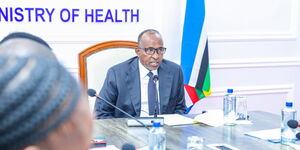
At the same time, he commended the team at the Ministry of Health, citing officials, including the CS Aden Duale, on speeding up the deliberations, PS Ouma Oluga, and the Attorney General’s office, for finalising the deal, and insisted that the pact represents a mutually beneficial collaboration rather than an imposition.
Ruto said he did not believe the United States “would want to take advantage of Kenya,” noting that the bilateral ties between the two countries span many sectors, from health to trade, defence, and tourism, making exploitation unlikely.
“I do not believe the U.S. would seek to take advantage of us, and those suggesting otherwise appear to lack understanding. Our partnership with the U.S. spans various sectors, including trade, defense, and tourism, among many others. This demonstrates the strength of our bilateral relations and reinforces that the U.S. would not want to exploit us,” he added.
The President accused detractors claiming otherwise of lacking intelligence, arguing that such continuity in relations points to mutual trust and long-term cooperation.
Ruto further insisted the deal aligns with Kenya’s drive to strengthen public health systems, and that the Kenyan institutions, not foreign intermediaries, will control and manage the benefits of the partnership.
Court Case
The developments come at a time when the Consumers Federation of Kenya (COFEK) has moved to the High Court to challenge the Ksh200 billion Kenya-US Health Cooperation Framework Agreement that was signed in Washington on December 4, by Prime Cabinet Secretary Musalia Mudavadi and U.S. Secretary of State Marco Rubio.
COFEK, in its court papers, argued that the deal violates the Constitution, the health law and that it was done discreetly.
“Once Kenya's medical and epidemiological data is transferred abroad, the harm becomes permanent and irreversible. Neither this Honourable Court nor Kenyan regulators would have the power to recall, restrict, or oversee how such data is used overseas,” the lobby told the court.
Adding that, “This exposes citizens to lasting privacy violations, stigma, and potential misuse of their information. The irreversible nature of this harm points to the urgency of the matter,” the lobby told the court.