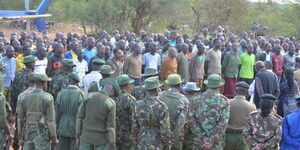

Interior Cabinet Secretary Kipchumba Murkomen has dismissed claims that the government intends to transfer the national Kiganjo Police Training College from Nyeri to the North Rift as part of efforts to address the long-standing problem of banditry in the region.
Speaking on Tuesday, 30 December, Murkomen said that despite government plans to establish several multi-agency training centres and schools in the region, including for the police and the Kenya Defence Forces, there are no plans to relocate Kiganjo from its current location.
''We have plans to set up training schools in those areas. Actually, what we want is a situation where after completing training classes at the current training schools, we want them to move to these disturbed areas for further training to enhance their expertise and orient them to what actually happens on the ground,'' the CS said.
''However, when I recently said that, someone started saying that I was meaning to close Kiganjo and take it to Marakwet. No, that is not what I meant,'' Murkomen clarified.

The CS said the service is shifting to a model where police practical training will be conducted in the field rather than in town-based centres where the three main colleges are currently located.
Separately, the National Police Service (NPS) has indicated that a revised training curriculum will now integrate forensics, modern technology, and cybercrime detection at the initial training stage, a departure from the previous approach where such specialised expertise was only introduced after officers were deployed to units such as the DCI.
Kenya’s basic police training is anchored in three main institutions: Kiganjo for regular police officers, Embakasi A for the Administration Police, and Embakasi B, which prepares recruits for the General Service Unit (GSU).
Other training institutions are largely advanced and specialised centres, among them the Magadi Police Training College, an extension of the Embakasi B campus that focuses on field-based training for GSU recruits and officers undertaking promotion courses, with emphasis on tactical and field craft expertise in Kajiado County.
At the same time, Murkomen revealed that the government has embarked on plans to establish a National Police University, with preparations now at an advanced stage.
Under the plan, Kiganjo will become one of the campuses of the proposed university, whose charter will be awarded by the President as part of broader reforms aimed at improving police training and professionalism.
''This idea we got from the Jukwaa la Usalama, where Kenyans had told us that the 9-month basic training which we offer our officers is not enough, and that is why we are advancing the plans. There must be continuous training for them to enhance their operational mandate.''
Meanwhile, amid renewed insecurity and rising tensions in the Kerio Valley, the government has announced plans to involve the KDF in stabilisation efforts through the establishment of training facilities in the region.
The CS said on Thursday, December 25, that from January 2026, the government will establish training facilities in the Kerio Valley for multiple security agencies, including the KDF, to boost readiness and support long-term peace.