
Former President Uhuru Kenyatta has dismissed claims that he is fuelling divisions within the Orange Democratic Movement (ODM), asserting that his recent political engagements are intended to promote national unity and stability rather than interfere in the party’s internal affairs.
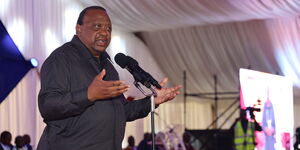
Speaking on Tuesday, December 30, during the burial of former Lugari MP Cyrus Jirongo, the retired head of state addressed the allegations from a section of ODM leadership. He characterized the accusations as "baseless propaganda" used by politicians to mask their own failures.
Uhuru warned his critics against mistaking his retirement for weakness or silence.
"I am retired, but let me be clear, if you poke me in the eye, I will poke back," Uhuru said. "Let us respect one another. I respect the political order and the multiparty space created through great struggle, and others should do the same."

The former president urged leaders who feel aggrieved to stop seeking scapegoats and instead focus on building their own political identities.
He told critics to focus on presenting clear, people-centred ideas to voters instead of hopping from one forum to another, exchanging accusations, he said add little value to the country’s progress.
His remarks came amid escalating tensions within the ODM party following the passing of its long-time leader, Raila Odinga.
Over the weekend, ODM chairperson Gladys Wanga had accused the former president of using intermediaries and insiders to undermine cohesion within the party.
Allies of the retired president, among them digital strategist Pauline Njoroge, say Kenyatta is being cast as a scapegoat to mask internal tensions between ODM’s old guard and a younger faction uneasy with the party’s closeness to the current administration.
Amid the sharp exchanges, the event saw a moment of reconciliation when ODM Secretary General Edwin Sifuna offered a public apology to Kenyatta on behalf of the party.
Sifuna criticized colleagues for being ungrateful for the role Kenyatta played in supporting the late Raila Odinga during the 2022 General Election.
He emphasised that the former president’s involvement in political discourse is rooted in goodwill and a desire to see a vibrant, democratic Kenya.
Kenyatta concluded by urging leaders from the Western region to take the initiative in national dialogue.
He urged leaders to prioritise dialogue and engagement among themselves first, before reaching out to counterparts from other regions to collectively chart the country’s future direction.