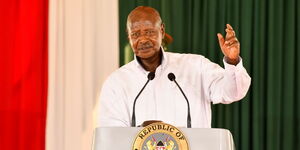

Ugandan President Yoweri Kaguta Museveni has declared January 15 and 16, 2026, as public holidays to allow citizens time to take part in the country’s presidential and parliamentary elections, which will be held next week after a contested period of presidential campaigns.
The announcement was made by Museveni through a Legal Notice issued under the Public Holidays Act, Cap. 174, formally gazetted by the government ahead of the polls.
"In exercise of the powers conferred upon the President by Section 2 (2) of the Public Holidays Act, I declare 15th and 16th January, 2026, to be observed as public holidays throughout Uganda for the purpose of enabling citizens to participate in the Presidential and Parliamentary elections," the notice read in part.
The government said the two-day break is intended to enable voters across the country to travel, queue, and cast their ballots without work-related interruptions.

The holidays will be observed nationwide, applying to both public and private institutions, as Uganda prepares for what is expected to be a closely watched election.
Museveni, who has been in power since 1986, is seeking another term, with the elections also set to determine the composition of Parliament.
Uganda’s 21.6 million registered voters will participate in three separate elections: the presidential contest, the election of 353 constituency Members of Parliament, and the selection of 146 women representatives, one from each district.
President Museveni and opposition leader Bobi Wine are the main contenders in the presidential race, marking their second face-off at the ballot.
Museveni, who is 81, won the 2021 election with 58 per cent of the vote against Bobi Wine’s 35 per cent, a poll that was overshadowed by allegations of rigging and a heavy crackdown on the opposition.
According to the Ugandan law, a candidate for president must win 50 per cent + 1 vote to avoid a runoff in the country's two-round voting system, even as many Ugandans continue to raise concerns over the credibility of the polls.
The Ugandan elections come nearly four months after neighbouring Tanzania held a hotly contested poll that was followed by post-election skirmishes in parts of the country.
President Samia Suluhu was declared the winner after results released by the Tanzanian Electoral Commission on Saturday, November 1, showed she had garnered 31.9 million votes, representing 97.66 per cent of the total votes cast.
The election was criticised by the international community and opposition groups, with the main challenger, Tundu Lissu, spending the pre-election and voting period in jail, while another key opposition figure was disqualified from the race.