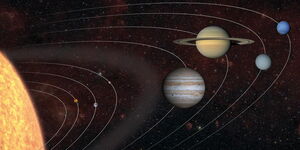

The Kenya Space Agency (KSA) has announced that planet Jupiter will appear bigger and brighter than usual in the night sky tonight, January 10, 2026, as Earth aligns directly between the Sun and the giant planet.
This cosmic positioning, known as opposition, allows Jupiter to remain luminous and visible throughout the night.
Opposition occurs roughly once a year and provides stargazers with the planet at its closest and brightest view of the year.
To catch sight of it, the agency has advised that interested watchers should look toward the eastern sky after sunset.

During this time, Jupiter will rise early and remain visible until dawn, glowing steadily in the constellation Gemini, which is its celestial home during this period.
"Jupiter is easily visible with the naked eye, but using binoculars, you’ll see its four largest moons, while a telescope offers a greatly enhanced viewing experience," KSA said.
For those with binoculars, Jupiter’s four largest moons, Io, Europa, Ganymede, and Callisto, can be seen. Those with access to a telescope will enjoy an even more detailed view, allowing them to observe the planet’s cloud bands and faint rings.
The Kenya Space Agency says this event presents a rare opportunity to inspire interest in astronomy and science among both young people and adults.
Amateur stargazers can use apps like Stellarium to locate the constellation Gemini and Jupiter, as the app guides users in real time, making it easier for beginners to spot celestial objects.
Meanwhile, Jupiter at opposition is also scientifically significant, as astronomers can use the proximity to study the planet’s atmosphere, magnetic field, and moons in greater detail.
In September last year, Kenyans across the country had the opportunity to witness a rare total lunar eclipse on Sunday, September 7, which produced a striking ‘blood moon’.
At the time, skywatchers were treated to an extraordinary sight, as the eclipse also coincided with the visibility of planet Saturn, a phenomenon that occurs only once or twice a decade.
A total lunar eclipse happens when the Earth moves directly between the Sun and the Moon, casting its shadow, or umbra, across the lunar surface.
During the event, the Moon appeared reddish as sunlight was filtered through the Earth’s atmosphere, giving it a distinctive red or copper-like glow.