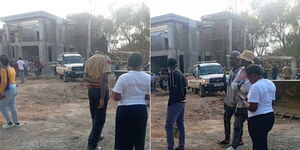

At least two people have been confirmed dead, and three others critically injured after a building under construction opposite Karen Community Church along Ngong Road collapsed.
The collapse happened at 5pm, and by 6pm, the Kenya Red Cross had evacuated three people. The Saturday evening collapse prompted an urgent emergency response amid growing concerns over further casualties.
According to an initial police report, the building under construction had reached the first-floor level when the floor caved in, leading to the deaths of two builders who were working on the site.
Seven others were rescued and rushed to the hospital for treatment. But there is a conflict on the number of those who have died from the incident.

Former Nairobi Governor Mike Sonko, while confirming the incident, claimed three had passed away. He said, "Another building has just collapsed in Karen near KCB. Several people are trapped inside. Three dead bodies have already been confirmed."
At the time of publishing this article, the police and the National Construction Authority (NCA) had not issued any statements on the collapse. However, DCI officers are among those at the scene probing the incident.
It also remains unclear how many people are trapped in the rubble, with response teams currently conducting rescue operations at the site.
The incident comes less than a fortnight after another 12-storey building collapsed in Nairobi's South C estate, leading to the death of two people.
Meanwhile, at the time of publishing, neither the Nairobi County government nor the National Disaster Management Unit had provided an update on the Karen building collapse.
The developments come after the Architectural Association of Kenya (AAK) had previously raised alarm over the safety of buildings in Nairobi, warning that a significant number of structures in the city are not fit for human occupation.
The concerns have been linked to poor enforcement of building regulations, corruption, and the use of substandard construction materials.
According to figures cited by built environment professionals, inspections carried out by the National Building Inspectorate found that only about 15 per cent of buildings assessed were structurally safe.
This means that about 85 per cent of the buildings inspected were either unsafe, required major structural improvements, or posed potential risks to occupants.