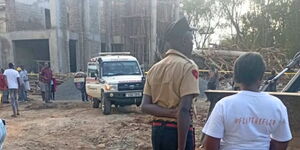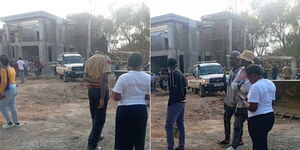

The Nairobi County Government has revealed that the use of substandard materials caused the collapse of the Nairobi Building in Karen, which claimed the lives of two people and left seven others nursing injuries.
In a statement on Saturday, January 10, County Executive Committee Member for Built Environment and Urban Planning Patrick Mbogo said that contractors at the site used timber gun tree supports instead of steel props for the double volume slab.
Furthermore, Mbogo indicated that poor workmanship and inadequate formwork also played a role in the collapse of the building.
"NCCG approved the architectural plans on 14th November 2024, while structural plans received approval on 27th November 2024," Mbogo said.

"Further investigations are ongoing and additional updates will be communicated as information becomes available," he added.
The residential building, which was under construction, collapsed at 5 pm at Plot No. 12882/197, located along Ngong View Lane, Karen Ward, within Lang’ata Sub-County, Southern Borough.
The collapse prompted a multi-agency emergency response from the Nairobi county government, Red Cross, among others, who managed to rescue those injured and take them to the hospital.
An initial police report said that the building had reached the first-floor level when the floor caved in, leading to the deaths of two builders who were working on the site.
The Nairobi County government, in collaboration with the National Construction Authority and the Directorate of Criminal Investigations, has camped on the site to investigate what exactly led to the collapse of the building.
The incident came less than two weeks after another 12-storey building, which was also under construction, collapsed in Nairobi's South C estate, leading to the death of two people.
The Architectural Association of Kenya (AAK), among other stakeholders, has linked these incidents to poor enforcement of building regulations, corruption, and the use of substandard construction materials.
According to figures cited by built environment professionals, inspections carried out by the National Building Inspectorate found that only about 15 per cent of buildings assessed were structurally safe.
About 85 per cent of the buildings inspected were either unsafe, required major structural improvements, or posed potential risks to occupants, according to the professionals.