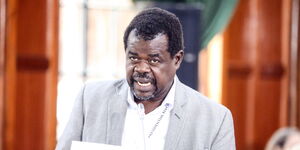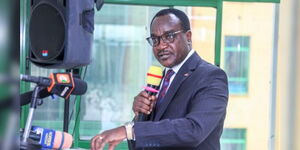

Busia Senator Okiya Omtatah has broken his silence following a High Court's decision to suspend implementation of the Kenya-US Health Cooperation Framework, particularly sections dealing with health data transfer.
Speaking in a press interview on Thursday, December 11, 2025, the outspoken legislator addressed the media after Justice Bahati Mwamuye issued conservatory orders stopping the deal until the case is fully heard.
"At the heart of this petition is the question, to whom does health data belong? And the answer emphatically is that they belong to each individual," Omtatah stated.
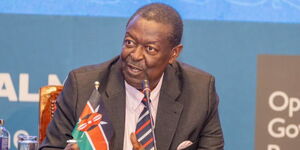
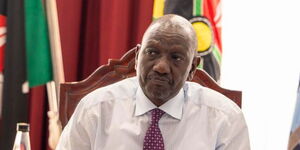
The agreement was signed in Washington, DC, on Thursday, December 4, 2025, by Prime Cabinet Secretary Musalia Mudavadi and US Secretary of State Marco Rubio, with President William Ruto in attendance.

Omtatah filed the petition alongside the Consumers Federation of Kenya (COFEK), arguing that the framework violates constitutional provisions on data privacy and sovereignty.
He raised concerns about historical medical experiments on black people, citing the Tuskegee syphilis trials in America.
"What guarantee do we have that we are not quickly opening up a laboratory of guinea pigs for experiments on various things?" he questioned.
The senator criticized the agreement for being structured outside constitutional frameworks, noting it claims not to be a treaty yet binds the government to financial commitments.
These include incremental funding of Ksh10 billion to Ksh50 billion over 5 years, thousands of employees to be recruited, and the transfer of health data without individual consent.
Justice Mwamuye suspended the sections that allowed for the transfer of medical, epidemiological or other sensitive personal health data.
The case will be mentioned on February 12, 2025 before Justice Lawrence Mugambi, who will provide directions for an expedited hearing.
Omtatah emphasised that the state cannot commercialise health data without individual consent.
He warned that, given its significance to national sovereignty and fundamental rights, the matter could end up in the Supreme Court.