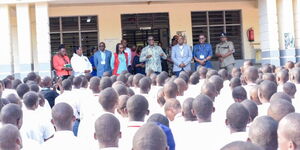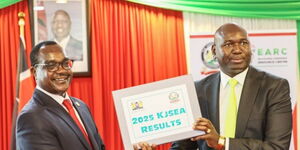

In the wake of the release of the Kenya Junior School Education Assessment (KJSEA), Education Cabinet Secretary Julius Ogamba has unveiled the full details of the inaugural national examinations, including the grading structure and learner placement criteria.
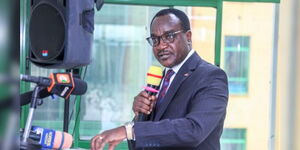
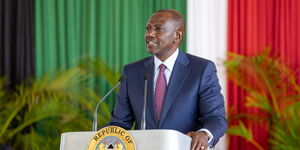
Speaking during the release of the KJSEA exam results at the Mtihani House in Nairobi on Thursday, December 11, the CS sought to provide clarity to parents, teachers and candidates transitioning to senior school next year.
He noted that the current competency-based assessment introduced under the Competency-Based-Curriculum (CBC) mainly relies on the performance levels of a student rather than traditional marks-based grading.
These levels include 'exceeding expectation', 'meeting expectation', 'approaching expectation' and 'below expectation'.

KJSEA 2025 Grading System
While KJSEA examinations adopted the four-band structure introduced under the CBC, the categories were further divided into two performance levels using an 8-point scale.
Point 8: Represents the highest level of exceeding expectations
Point 1: Represents the lowest level below expectations
According to Ogamba, the aforementioned broader categories allow examiners to distinguish exceptional performance from good performance, ensuring fairness in the assessment.
"The reporting of performance of KJSEA has thus been done from point 1 to point 8, where point 8 is the best at 'exceeding expectation' and point 1 is the least at 'below expectation,'" Ogamba said.
He went on to add, "The creation of these bands serves to distinguish exemplary performance from good performance."
Ogamba also revealed subjects with the strongest performance, noting that out of the 12 subjects offered in the KJSEA, seven recorded a higher proportion of learners performing at meeting and exceeding expectations.
These include Hindu Religious Education (84%), Integrated Science (61%), Social Studies (58.7%), Creative Arts & Sports (58.04%), Kiswahili (57.9%), Christian Religious Education (53.9%) and Agriculture (52%).
Placement in Senior School
According to Ogamba, the final assessment of Grade 9 learners was drawn from three components: 20% from Kenya Primary School Education Assessment (KPSEA), 20% from school-based assessments in Grades 7 and 8 and 60% from the summative KJSEA evaluation in Grade 9.
"This summative evaluation is the KJSEA," Ogamba stated, noting that the final examination was to ensure a comprehensive assessment of the learners transitioning to grade 10.
"An approaching expectation grade is sufficient for learners to progress to senior school pathways that require basic competencies in the subject areas," the CS clarified.