
The government has appealed for financial support from private companies and human rights organisations to help address a growing hunger crisis affecting more than two million Kenyans, due to prolonged drought.
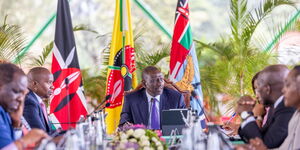
Speaking on Tuesday, December 16, during a high-level meeting with humanitarian organisations, development partners, and private sector representatives, Kindiki highlighted that the government required over Ksh13 billion to support urgent humanitarian and livestock interventions.
Kindiki noted that at least 32 counties were currently experiencing food insecurity, with 10 counties classified as critical due to severe drought conditions.
“About 2.1 million people in Kenya are food insecure at the moment. Weather forecasts indicate that the short rains are likely to come to an end by the end of 2025. The situation may persist or worsen in January, February, and March,” Kindiki noted.

He noted that the government required Ksh7 billion over the next three months for human-related interventions, including food assistance, nutrition, health services, and water supply, as well as Ksh6 billion for livestock support.
“The intervention we require for the next three months is human-related interventions for food, nutrition, and health-related, including water, and then livestock-related interventions,” the DP stated.
The 10 counties facing critical conditions are Wajir, Mandera, Garissa, Kilifi, Kitui, Marsabit, Kwale, Kajiado, Isiolo, and Tana River.
Wajir County has been identified as one of the worst-hit areas, with families struggling to access food as livestock perish due to dried-up water sources and depleted grazing fields.
Other counties, including Narok, Samburu, Turkana, and Meru, are also at risk of sliding into critical conditions if the drought persists.
The government warned that urgent intervention is required to prevent loss of life, stating that affected counties need immediate support in food, water, and healthcare services as drought conditions continue to threaten livelihoods across arid and semi-arid regions.
A recent report by the Kenya Meteorological Department (KMD) warned of a drier December, characterised by poor rainfall distribution and prolonged dry spells, particularly in the northeastern and coastal regions.
President William Ruto, during the recent State of the Nation address, outlined a sweeping water and irrigation plan to boost food security and mitigate food insecurity risks.
The irrigation plan comprises the construction of 50 mega dams, 200 medium and small dams and thousands of microdams across the country.
According to the President, the investments are set to bring in at least 2.5 million acres under irrigation within the next five to seven years to turn water-scarce areas into productive agricultural hubs.
In terms of location, Ruto targets areas across the Republic, from High Grand Falls on the Daua River in Mandera to Soin Koru in Kisumu, Rumuruti in Laikipia, Kokwanyo in Homa Bay, Thuci in Embu and Tharaka-Nithi. Expanded irrigation will not only secure food supplies, but will also fuel agro-industrialisation by providing quality raw materials for special economic zones.