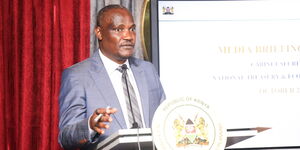

The government has announced a last-ditch effort to avert a deepening food and livestock crisis through averting several World Bank-funded agricultural projects.
According to Agriculture Cabinet Secretary Mutahi Kagwe, national and county leaders have agreed to reprogram donor funding initiatives to prioritise drought relief, particularly in the Arid and Semi-Arid Lands (ASAL) regions.
The decision was arrived at following a high-level meeting in Malindi, where the national government, the Council of Governors (CoG) Agriculture Committee, and the ASAL Governors Caucus agreed that the gravity of the drought situation called for a coordinated, all-of-government approach to tackle the crisis.
At the centre of the restructuring are two major World Bank-supported programmes - the Food Systems Resilience Program (FSRP) and the National Agricultural Value Chain Development Project (NAVCDP).

The FSRP is currently implemented in 13 counties, which have been classified as severely affected by drought, while NAVCDP typically covers the remaining 34 counties.
But according to Kagwe, following the discussions, both programmes will be re-wired to ensure counties facing acute drought receive immediate assistance, including water delivery to pastoral areas, livestock disease control, transportation of fodder, and interventions to protect households that depend on livestock.
“We sit at a critical point where we must reprogramme these two programmes to respond to the current drought reality, while also putting in place permanent solutions to avert future crises,” Kagwe said.
As part of the restructuring, some activities which were originally planned under the projects will be paused, and the funds will be redirected to urgent drought mitigation needs, especially in counties where there are increased cases of livestock losses due to prolonged lack of rainfall.
Leaders also agreed that at east 85 per cent of the programme resources should be channelled directly to activities on the ground and not to administrative and recurrent costs.
In terms of implementation, counties will play a central role in planning the restructured programs, with CoG Agricultural committee chair and Bungoma Governor Kenneth Lusaka insisting the donor-funded initiatives must be jointly designed by national and county governments.
“Capacity-building funds must be reallocated. Going forward, resources will no longer be absorbed by recurrent expenditure,” Lusaka said.
On Tuesday, Deputy President Kithure Kindiki also admitted that the government was in need of more funding from donors to curb the worsening drought, with Kenyans now unable to rely on rain-fed agriculture.
Speaking on Tuesday, December 16, during a high-level meeting with humanitarian organisations, development partners, and private sector representatives, Kindiki highlighted that the government required over Ksh13 billion to support urgent humanitarian and livestock interventions.