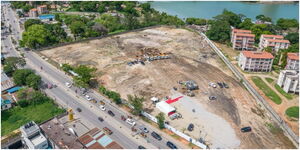

Nairobi County has today, December 20, ordered high-rise developers in Kileleshwa to pay for the damages they caused to public infrastructure, after complaints over blocked water and sewer lines led to flooding and environmental concerns.
This was after the Embassy of the Netherlands filed a complaint that construction near their premises had obstructed sewage and water flow, raising environmental and health concerns.
The embassy also raised the issue of the destruction of walkways and sewer lines by the ongoing construction.
“Discharge of wastewater from the construction site into the storm drain that flows into the river poses both environmental and public health concerns. We respectfully request that the relevant authorities review these matters and take appropriate action to prevent environmental hazards and maintain public safety,” the statement stated.

Residents from Dikdik Gardens in Kileleshwa also raised the same issue, adding that the raw sewage was contaminating the Kirichwa Ndogo River.
They urged the National Construction Authority (NCA) and the National Environmental Authority (NEMA) to pause the construction until the issue was resolved.
“We’d like to ask the county, as well as agencies like NCA and NEMA, to put a pause on the construction until they address the issues that residents have raised here in Dikdik and the wider Kileleshwa area,” one of the residents stated.
The embassy's alarm over the destruction of government infrastructure was a part of the wider pattern of high-rise buildings posing risks to Kenyans. In Peponi Road, Westlands, Nairobi, the construction of a 13-storey building was halted after it developed cracks on its pillars, leading to the evacuation of the neighbouring residents.
Earlier in April this year, the Parklands Residents Association obtained a court order against developers who had destroyed roads, lanes, and old residential houses and felled trees at City Park Forest.
Residents of Lavington/Mbaazi Avenue filed a complaint with the Supreme Court of Kenya in November, claiming that a 16-story project's deep excavations endangered the structural stability of neighbouring four-story townhouses that shared subterranean rock formations.
Homeowners on Kilimani's Kindaruma Road reported in September that vibrations from heavy machinery on a nearby "beacon-to-beacon" construction site that shared a wall with their houses had caused cracks in the walls of their bedrooms.
In response, Nairobi City County opened a six-month amnesty in December, allowing developers to regularise unauthorised buildings while warning that structures on public land or violating court orders faced demolition.
Earlier, in September 2025, the Court of Appeal had ordered the county to publish a transparent zoning framework within six months to resolve conflicts between developers and residents.