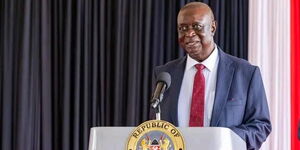

The year 2025 marked a series of unprecedented security breaches for President William Ruto, ranging from physical assaults to lethal intrusions at the heart of the state’s power.
Security experts say that for a head of state, the top priority is proactive measures, relying on intelligence gathering and meticulous planning to prevent threats before they arise.
While the public often focuses on the physical presence of bodyguards, elite security agencies like the Secret Service or Kenya's Presidential Escort Unit operate on the philosophy that if a security team has to draw a weapon, the security plan has already failed.
2025 will be remembered as a year when the security surrounding President Ruto faced repeated tests, from physical breaches to cyber intrusions, revealing vulnerabilities in both traditional and digital protection systems.
The incidents ranged from seemingly minor public disruptions to serious attacks at the highest-security installations in the country.

Migori and Kisumu Incidents
The first major scare came on May 4, when a shoe was hurled at President Ruto during a public rally in Migori County. The projectile struck or came dangerously close to the President, prompting immediate arrests and tightening of security protocols around public engagements.
Later that same month, on 30 May, another incident raised questions about crowd management after youths were filmed unusually close to the President’s helicopter during a visit to Kisumu. Although no physical harm occurred, the proximity of the crowd to a presidential aircraft triggered concerns over perimeter control.
Ruto Rhino Charge
Wildlife safety also emerged unexpectedly as a security issue when a rhino charged in President Ruto’s direction during a ceremonial release at a conservancy in Taita-Taveta on December 9. Rangers intervened before the animal made contact, in the moment that went viral with Kenyans expressing mixed reactions.
President's Briefing Abduction
Earlier in February, national security alarms were raised after five chiefs were abducted in Mandera County while preparing for a presidential security briefing. President Ruto assured that extremists would not compromise national security, and the chiefs were eventually released through negotiations.
State House Breach
The most serious breach occurred in October at State House, Nairobi, when a spear-wielding intruder fatally attacked a General Service Unit officer stationed at Gate D. The President was within the compound during the attack, which shocked the nation and raised questions about the security of the country’s most fortified facility.
Earlier in the year, security forces also intercepted a group of youths attempting to enter the State House perimeter under the guise of seeking an audience with the President. While no violence was reported, the incident reinforced concerns about how easily individuals might test or probe restricted areas.
Cyber Attacks
Beyond physical breaches, 2025 also exposed cyber vulnerabilities closely tied to the presidency. Early in the year, the Business Registration Service experienced a major data breach, with sensitive records, including those linked to the President and other high-profile families, allegedly accessed and briefly offered for sale.
In November, several high-level government websites, including those linked to the State House, were hacked and defaced in what was described as a suspected coordinated cyberattack. Although authorities stated that no personal or government data was lost, the event signalled a worrying lapse in cyber-resilience.
Taken together, these incidents, ranging from targeted attacks to opportunistic breaches, reflect the challenges of protecting a modern presidency in an era where threats exist both offline and online.
They also sparked political debate, with some Kenyans questioning whether security agencies have kept pace with evolving risks, while others argued the incidents were isolated and symptomatic of the open, public-facing nature of presidential duties.