
President William Ruto has announced that the government is drafting a new law that would make drug and substance abuse-related offences a capital offence, punishable by hanging. The move is intended to intensify the fight against narcotics and illicit alcohol in Kenya.
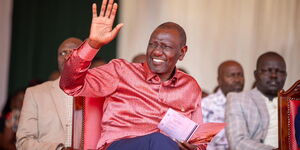
Speaking during an engagement ceremony in Uasin Gishu County on Saturday, January 3, the Head of State defended his tough stance, adding that he was ready to face any consequences arising from the push for stricter laws.
He said that the proposed legislation will specifically target individuals involved in the sale of illicit alcohol and hard drugs.
The president argued that the current penalties have not been effective in deterring traffickers, leaving families and communities exposed to ongoing harm.
Ruto explained that existing laws allow those caught selling substances such as heroin to pay a fine of Ksh1 million. The President stated that the new law would scrap this provision and instead introduce the death penalty for offenders.
“For all these people who are involved in the illicit alcohol trade, we are going to change the law. In the past, we had a law with a clause that if you were caught selling substances, including hard drugs such as heroin, the only penalty was a fine of Ksh1 million. Now we are changing that so that you can be hanged,” Ruto said.
“You know that if I have said it, I have said it, and I am ready to deal with the consequences. We need to have order. So many families are suffering because of cocaine,” He continued.
The President added that the proposed law, which will be tabled in Parliament, will also allow the state to confiscate assets linked to the sale of illicit alcohol and drugs. This includes vehicles and other property acquired through proceeds of the illegal trade.
Ruto called on Members of Parliament to support the new legislation, arguing that the estimated five million Kenyans affected by drug abuse represent an unsustainable crisis.
The announcement comes just days after President Ruto revealed plans to establish a new police unit within the Directorate of Criminal Investigations (DCI) as part of renewed efforts to crack down on illicit substance consumption and the financial networks behind the trade.
During his New Year's address at Eldoret State Lodge on Wednesday, December 31, the President said the government would set up a strengthened Anti-Narcotics Unit (ANU) within the DCI, with capabilities similar to the elite Anti-Terrorism Police Unit (ATPU).
President Ruto explained that officers assigned to the unit will undergo advanced paramilitary training, equipping them with specialised skills and tactics to more effectively target organised and high-risk criminal groups.
He emphasised that the new unit will not replace the National Authority for the Campaign Against Alcohol and Drug Abuse (NACADA), but will instead complement its work as a fully resourced formation.
The President added that the unit will be equipped with modern surveillance, intelligence, forensic, and financial investigation tools, enabling it to function as a permanent, multi-agency team working closely with NACADA.