
The fate of one of Kenya's most iconic elephants hangs in the balance as conservationists weigh preservation against nature's cycle.
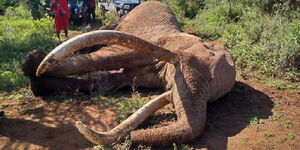
Elephant Craig, who died on Saturday, January 3, 2026, famed for his massive tusks, could end up in a museum or be returned to the wild ecosystem.
The Kenya Wildlife Service (KWS) has outlined two possible paths for the legendary animal's remains.
According to KWS, it values an animal while alive, prioritizing its well-being above all else.

“We value an animal more while it is alive than when it is dead, and our first duty is always to its well-being and preservation,” stated KWS.
According to KWS, with the eventual passing of Craig, his impressive tusks will be the priority for conservationists.
Conservation officials are exploring moving his remains to the National Museums of Kenya in Nairobi.
"There is a strong intent to preserve Craig's remains at the National Museum, similar to the iconic elephant Tim, who died in 2020," KWS revealed to Kenyans.co.ke.
The death of a wild animal in Kenya triggers established legal and conservation procedures, overseen by the Kenya Wildlife Service, with the response differing depending on how the animal died.
According to KWS, the primary factor guiding the response is determining whether the animal died from natural causes, human-wildlife conflict, poaching, or other reasons.
This status dictates the subsequent steps, which are all conducted under the framework of the Wildlife Conservation and Management Act (WCMA).
If an animal is killed after attacking livestock or damaging crops, the carcass becomes part of an official investigation. This process is crucial for verifying incidents and facilitating potential compensation claims for affected community members, as outlined by law.
In cases where a death poses a risk to public safety or health, such as on a roadway or near a settlement, KWS will promptly remove the carcass. The overarching goals in these situations are to prevent the spread of disease and ensure community well-being.
For animals with valuable parts, such as tusks or rhino horn, the state takes custody. These remains are processed as "Government Trophy" and are securely stored or disposed of to prevent any illegal wildlife trade.
KWS stresses that every action is taken with the dual aims of public benefit and the long-term conservation of the species.