
Two Kenyan pilots have broken their 31-year silence about a covert operation to transport the body of Somalia's former ruler, Siad Barre, from Lagos, Nigeria, to his hometown in Somalia for burial.
While speaking to the BBC, Hussein Mohamed Anshuur and Mohamed Adan revealed they were approached by a Nigerian diplomat at their office at Wilson Airport near Nairobi on January 9, 1995. The diplomat asked them to charter an aircraft and secretly transport Barre's body from Lagos to Garbaharey in southern Somalia, a distance of approximately 4,300 kilometres.
"We knew immediately this wasn't a normal charter," Anshuur said in his first media interview about the mission. The diplomat requested that the flight be organised outside routine procedures. "If the Kenyan authorities found out, it could have caused serious problems."
Barre had died in exile in Nigeria at age 80, four years after being overthrown by militia forces in 1991. He had initially fled to Kenya, but President Daniel Arap Moi's government came under pressure for hosting him. Nigeria gave Barre political asylum, where he lived until dying of a diabetes-related illness.

The pilots spent the day debating whether to accept the offer. They weighed the risks carefully, particularly if the Kenyan government were to discover their plans. The financial offer was lucrative, though they declined to reveal the amount. "We first advised him to use a Nigerian Air Force aircraft, but he refused," Anshuur recalled.
Ayaanle Mohamed Siad Barre, the former ruler's son, also spoke to the media for the first time about the mission. He said the secrecy was not about hiding anything illegal. Islamic tradition requires burial as soon as possible. "Time was against us," he said. "If we had gone through all the paperwork, it would have delayed the burial." Nigerian officials told him Garbaharey's runway was too small for a military aircraft.
The pilots demanded guarantees from Nigeria before proceeding. "That if anything goes wrong politically, Nigeria must take responsibility," Anshuur said. They also wanted two embassy officials on board. Nigeria agreed.
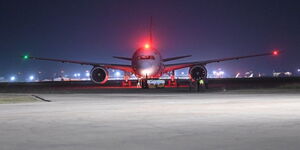
Just after 03:00 on January 11, their Beechcraft King Air B200 took off from Wilson Airport. The pilots filed a flight manifest listing Kisumu as their destination. "That was only on paper," Anshuur said. "When we got close to Kisumu, we switched off the radar and diverted to Entebbe in Uganda."
Radar coverage across the region was limited at the time. Upon landing in Entebbe, they told authorities the aircraft had arrived from Kisumu. The two Nigerian officials were instructed to remain silent. After refuelling, they flew to Yaoundé in Cameroon, then continued to Lagos.
Before entering Nigerian airspace, the government instructed them to use a Nigerian Air Force call sign "WT 001." "That detail mattered," Anshuur said. "Without it, we might have been questioned." They arrived in Lagos around 13:00 on January 11.
On January 12, Barre's wooden casket was loaded onto the aircraft with the two Nigerian officials and six family members. "At no point did we tell airport authorities in Cameroon, Uganda or Kenya that we were carrying a body," Anshuur said. "That was deliberate."
The aircraft retraced its route through Yaoundé and Entebbe. As they neared Kisumu, the pilots diverted directly to Garbaharey. After the burial, they departed for Wilson Airport. Anshuur said this was the most stressful part. "You think: 'This is where we could be stopped.'"
They informed Wilson air traffic control they were arriving from Mandera in northeastern Kenya, giving the impression of a local flight. "No-one asked questions," Anshuur said. "That's when we knew we were safe."
Asked whether he would undertake a similar mission today, the now 65-year-old pilot said no. "I would not carry out a similar mission today because aviation technology has improved so much that there is now sufficient air traffic radar coverage within the African continent. It is virtually impossible to exploit the gaps in air traffic control that existed way back in 1995."